Baiyun has embarked on a journey.
There are $n$ cities in total, numbered from $1$ to $n$, with some roads connecting them. The road structure can be abstracted as a cactus graph. An undirected connected graph is called a cactus if every edge belongs to at most one simple cycle. A simple cycle is a cycle that does not visit any node more than once.
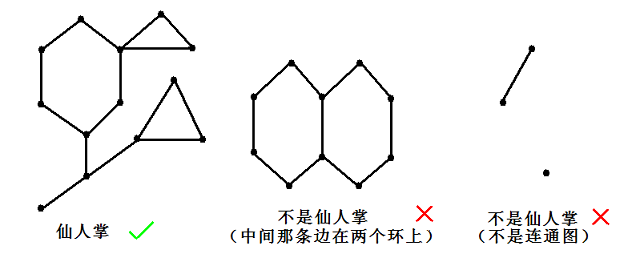
Baiyun has a preference value for each road between these cities. The preference value of a path is the product of the preference values of all roads on that path.
Now, Baiyun is preparing to depart from city $1$. To plan a reasonable route, Baiyun occasionally asks Baitu: "What is the sum of the preference values of all paths from city $1$ to city $k$ that do not traverse the same road twice?"
This has stumped Baitu. Please help calculate the corresponding answer for $k=1, 2, \ldots, n$. You only need to output the answer modulo $998244353$ ($= 7 \times 17 \times 2^{23} + 1$, a prime number).
Input
The first line contains two positive integers $n$ and $m$, representing the number of cities and the number of roads. It is guaranteed that $n \ge 2$.
Each of the next $m$ lines contains three positive integers $v, u, w$ ($1 \le v, u \le n, 1 \le w < 998244353$), representing a road connecting city $v$ and $u$ with a preference value of $w$.
It is guaranteed that the input graph is a cactus, has no self-loops, but may contain multiple edges.
Output
Output $n$ lines, where the $i$-th line contains an integer representing the answer for $k=i$.
Examples
Input 1
11 11
1 2 1
2 3 1
3 4 1
4 5 1
5 6 1
6 1 1
2 7 10
3 8 20
4 9 30
5 10 40
6 11 50
Output 1
3
2
2
2
2
2
20
40
60
80
100
Note 1
Note that two paths are considered different if they consist of a different sequence of edges, or if there exists an $x$ such that $1 \le x \le \text{path length}$ where the $x$-th edge traversed by the two paths is different.
A path of length $0$ is also a valid path, and its weight is considered to be $1$.
Subtasks
For all data, $n \le 10^5, 1 \le w < 998244353$.
| Subtask ID | $n \le$ | $w \le$ | Other Constraints |
|---|---|---|---|
| 1 | $10^5$ | $1$ | $m=n-1$ |
| 2 | $998244352$ | ||
| 3 | $8$ | ||
| 4 | $10^5$ | $1$ | Each node is in at most one cycle |
| 5 | $998244352$ | ||
| 6 | $500$ | ||
| 7 | $3000$ | $1$ | |
| 8 | $998244352$ | ||
| 9 | $10^5$ | $1$ | |
| 10 | $998244352$ |
Although the range for $m$ is not explicitly given, those familiar with cactus graphs know that for a cactus, it must satisfy $n-1 \le m \le 2n-2$.