Bajtazar is buying furniture online. He has already found a nice table and a set of chairs. Now he is wondering how many chairs he can buy so that they all fit at the table.
The table has a rectangular top with dimensions $ A \times B $ centimeters. The seat of a chair, viewed from above, is a square with dimensions $ K \times K $ centimeters. We will treat the table as a rectangle and the chairs as squares.
There is a backrest along one of the edges of the seat (the square). Each chair must be placed with its backrest against the table, meaning the edge with the backrest must coincide with an edge of the table. Furthermore, the seat must be entirely under the tabletop. Naturally, no two chairs may overlap. In our considerations, we ignore the table legs (we can assume they are infinitely thin and located at the corners of the tabletop). How many chairs will fit under the table?
Input
The only line of input contains three integers $ A $, $ B $, and $ K $ ($1 \le A, B, K \le 500\,000\,000$) representing the dimensions of the tabletop and the dimension of the chair seat, respectively.
Output
Your program should output the maximum number of chairs that can fit at the table.
Examples
Input 1
15 18 4
Output 1
10
Note
The figure shows an example arrangement of chairs at the table. The backrests are marked with bold segments. It is not possible to place eleven chairs.
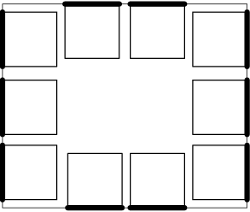
Input 2
12 8 4
Output 2
6