Xiao z gave Xiao m a malicious problem.
Xiao m does not know how to solve it, so she starts writing a brute-force search. Although Xiao z once said: "Theoretical complexity has no direct relationship with runtime efficiency," Xiao m still wants to know the theoretical complexity of her brute-force search. She discovered that the number of search iterations is equivalent to the number of ways to fill numbers into a tree.
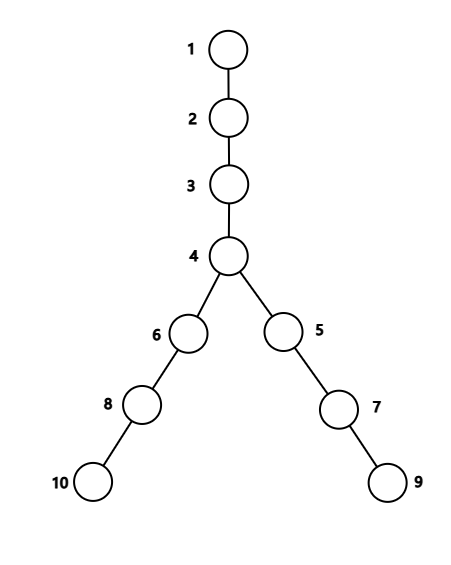
This tree has $10^{10^{10}}$ nodes, numbered starting from $1$. Let $r \ge 1$ be a parameter. For a node with index $i$, if $2 \leq i \leq r + 1$, its parent is the node with index $i-1$; if $r + 2 \leq i$, its parent is the node with index $i-2$.
The figure below shows a tree with $r=4$, showing only a small part at the top. Each circle represents a node, and the number next to the circle is the node's index.
Now, Xiao m wants to fill each node with a number. The filling must satisfy three conditions:
- The filled numbers must be non-negative integers.
- For the $i$-th node ($i \ge 2$), the number filled in its parent must be no less than the number filled in the node itself.
- The sum of all filled numbers must be exactly $n$.
Xiao m wants to know, for each $n \in [1, N]$, how many ways there are to fill the numbers. However, she also realizes that the number of ways is very large, so you only need to output the answer modulo $998244353$.
Input
A single line containing two integers $N$ and $r$, representing the maximum sum of the numbers and the shape of the tree, respectively.
Output
A single line containing $N$ integers, where the $i$-th integer represents the number of ways for $n=i$, modulo $998244353$.
Examples
Input 1
9 4
Output 1
1 2 3 5 8 14 22 36 56
Note 1
For $n=5$, the possible ways are:
- $[5]$
- $[4,1]$
- $[3,2]$
- $[3,1,1]$
- $[2,2,1]$
- $[2,1,1,1]$
- $[1,1,1,1,1]$
- $[1,1,1,1,0,1]$
Here, the $i$-th number represents the value filled in the $i$-th node, and any nodes not listed are filled with $0$.
Input 2
See attachment.
Constraints
| Subtask | $N \leq$ | $r \leq$ | Score |
|---|---|---|---|
| $1$ | $100$ | $20$ | $10$ |
| $2$ | $1000$ | $100$ | $20$ |
| $3$ | $500000$ | $1$ | $10$ |
| $4$ | $2$ | $30$ | |
| $5$ | $500$ | $30$ |
For all data, $1 \leq N \leq 500000, 1 \leq r \leq 500$.