Kaguya is a playful girl.
One day, she is playing a tower defense game. The game map can be viewed as a 2D plane. Kaguya has already built $n$ defense towers, where the $i$-th tower is located at point $A_i$ with coordinates $(x_i, y_i)$.
Defense towers require sufficient energy to operate, so Kaguya needs to choose a location $O$ to build an energy source. Once the energy source is built, the defense range of the $i$-th tower is defined as the circle centered at $A_i$ that passes through point $O$ (including the boundary).
Kaguya discovers that after building the energy source, some defense towers might become redundant. To save energy, she wants to remove as many defense towers as possible while keeping the total defense range (the region covered by at least one defense tower's range) unchanged.
Now, Kaguya has $m$ plans for the energy source location $O_j$ with coordinates $(a_j, b_j)$. For each plan, she wants you to calculate the maximum number of defense towers that can be removed.
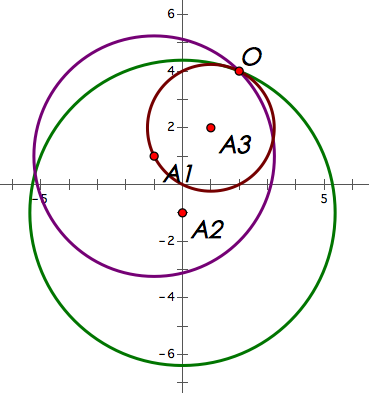
For example, when the coordinates of three defense towers are $(-1, 1), (0, -1), (1, 2)$ and the energy source coordinate is $(2, 4)$, the defense range is shown in the figure below. Clearly, at most one defense tower can be removed.
Input
The first line contains two positive integers $n (n > 1)$ and $m$.
The next $n$ lines each contain two integers $x_i, y_i (|x_i|, |y_i| \leq 10^9)$, representing the coordinates of the defense towers.
The next $m$ lines each contain two integers $a_i, b_i (|a_i|, |b_i| \leq 10^9)$, representing an energy source plan.
It is guaranteed that all points (including defense tower coordinates and energy source plans) have distinct $x$-coordinates and distinct $y$-coordinates.
Output
For each energy source plan, output one integer per line representing the maximum number of defense towers that can be removed while keeping the defense range unchanged.
Examples
Input 1
4 2
0 -1
-1 1
1 2
2 4
-3 3
3 -2
Output 1
2
1
Subtasks
This problem is divided into 4 subtasks. You must pass all test cases in a subtask to receive the points for that subtask:
Subtask 1 (11 points): $n \leq 3, m \leq 100$.
Subtask 2 (36 points): $n \leq 50, m \leq 100$.
Subtask 3 (29 points): $n, m \leq 3000$.
Subtask 4 (24 points): $n, m \leq 2 \times 10^5$.