QOJ.ac

QOJ

时间限制: 20 s - 40 s 内存限制: 1024 MB 总分: 20

#12459. 套娃多边形

统计

套娃(matryoshka)是一种起源于俄罗斯的玩偶,已有超过一个世纪的历史。其定义特征是它们由一套大小各异的玩偶组成,较小的玩偶可以完美地嵌套在较大的玩偶内部。

在本题中,我们研究“套多边形”(matrygon),这是一组遵循类似嵌套模式的正凸多边形。一个套多边形由一组面积为正的正凸多边形组成,使得对于所有 $i$,多边形 $p_{i+1}$ 的顶点与多边形 $p_i$ 的顶点的真子集重合($p_{i+1}$ 的顶点数严格少于 $p_i$ 的顶点数)。

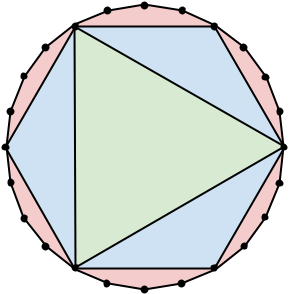
例如,下图展示了两个套多边形。第一个包含 3 个正凸多边形:一个正二十四边形(24 条边)、一个正六边形(6 条边)和一个等边三角形(3 条边)。第二个包含 2 个正凸多边形:一个正二十二边形(22 条边)和一个正十一边形(11 条边)。这两个套多边形中所有多边形的边数之和均为 33。
给定一个固定的总边数 $N$,计算一个套多边形中最多能包含多少个多边形,使得其中所有多边形的边数之和恰好为 $N$。

输入格式

输入的第一行包含测试用例的数量 $T$。接下来有 $T$ 行,每行代表一个测试用例,包含一个整数 $N$,即目标总边数。

输出格式

对于每个测试用例,输出一行 Case #x: y,其中 $x$ 是测试用例编号(从 1 开始),$y$ 是套多边形中多边形的最大数量,使得所有多边形的边数之和恰好为 $N$。

数据范围

$1 \le T \le 100$。 $3 \le N \le 10^6$。

样例

样例输入 1

3
33
15
41

样例输出 1

Case #1: 3
Case #2: 2
Case #3: 1

说明

题目描述中展示的第一个套多边形是样例 1 的最优解。

在样例 2 中,我们可以通过将一个正五边形(5 条边)嵌套在一个正十边形(10 条边)内得到两个多边形。

在样例 3 中,无法创建包含多个正多边形的套多边形,因此唯一的选择是使用一个单独的正四十一边形(41 条边)。

Discussions

About Discussions

The discussion section is only for posting: General Discussions (problem-solving strategies, alternative approaches), and Off-topic conversations.

This is NOT for reporting issues! If you want to report bugs or errors, please use the Issues section below.

Open Discussions 0
No discussions in this category.

Issues

About Issues

If you find any issues with the problem (statement, scoring, time/memory limits, test cases, etc.), you may submit an issue here. A problem moderator will review your issue.

Guidelines:

  1. This is not a place to publish discussions, editorials, or requests to debug your code. Issues are only visible to you and problem moderators.
  2. Do not submit duplicated issues.
  3. Issues must be filed in English or Chinese only.
Active Issues 0
No issues in this category.
Closed/Resolved Issues 0
No issues in this category.