Little C learned about the "left-child right-sibling representation" in a data structures class. For a rooted multi-way tree, we can convert it into a binary tree using this representation. Formally, given a rooted tree $T$ with $n$ nodes, labeled $1, 2, \dots, n$, where node $1$ is the root, we convert it into a binary tree $T'$ that also contains $n$ nodes and is rooted at node $1$ using the following representation: For each node $u$ in the tree, suppose its children are $v_1, v_2, \dots, v_k$.
- You can specify any order for these children, denoted as $v'_1, v'_2, \dots, v'_k$.
- In the tree $T'$, the left child of node $u$ is $v'_1$; for any $i \in [1, k-1]$, the right child of node $v'_i$ is $v'_{i+1}$.
We define two binary trees as different if and only if there exists a node $u$ such that its left child is different in the two trees (or one has a left child and the other does not), or its right child is different in the two trees (or one has a right child and the other does not). We define the subtree size of a node as the number of nodes in its subtree (including itself).
Little C noticed that under this representation, there are many possible forms for the final tree $T'$. Now, given a tree $T$, among all possible trees $T'$ that can be obtained using the "left-child right-sibling representation," Little C defines a "good representation" as one where the sum of the subtree sizes of all nodes is minimized. Little C wants to know the sum of the subtree sizes of all nodes for a "good representation" $T'$, and how many different "good representations" exist.
Input
The first line contains an integer $n$ ($1 \le n \le 10^5$), representing the number of nodes in the tree. The second line contains $n-1$ integers $f_2, f_3, \dots, f_n$ ($1 \le f_i < i$), where $f_i$ represents the parent of node $i$.
Output
Output two lines, each containing an integer. The first line represents the sum of the subtree sizes of all nodes in a "good representation" $T'$. The second line represents the number of "good representations" $T'$, modulo $998244353$.
Examples
Input 1
5
1 1 1 2
Output 1
13
2
Input 2
5
1 1 1 1
Output 2
15
24
Note
For the first example, all possible trees $T'$ obtained from $T$ using the "left-child right-sibling representation" are shown below:
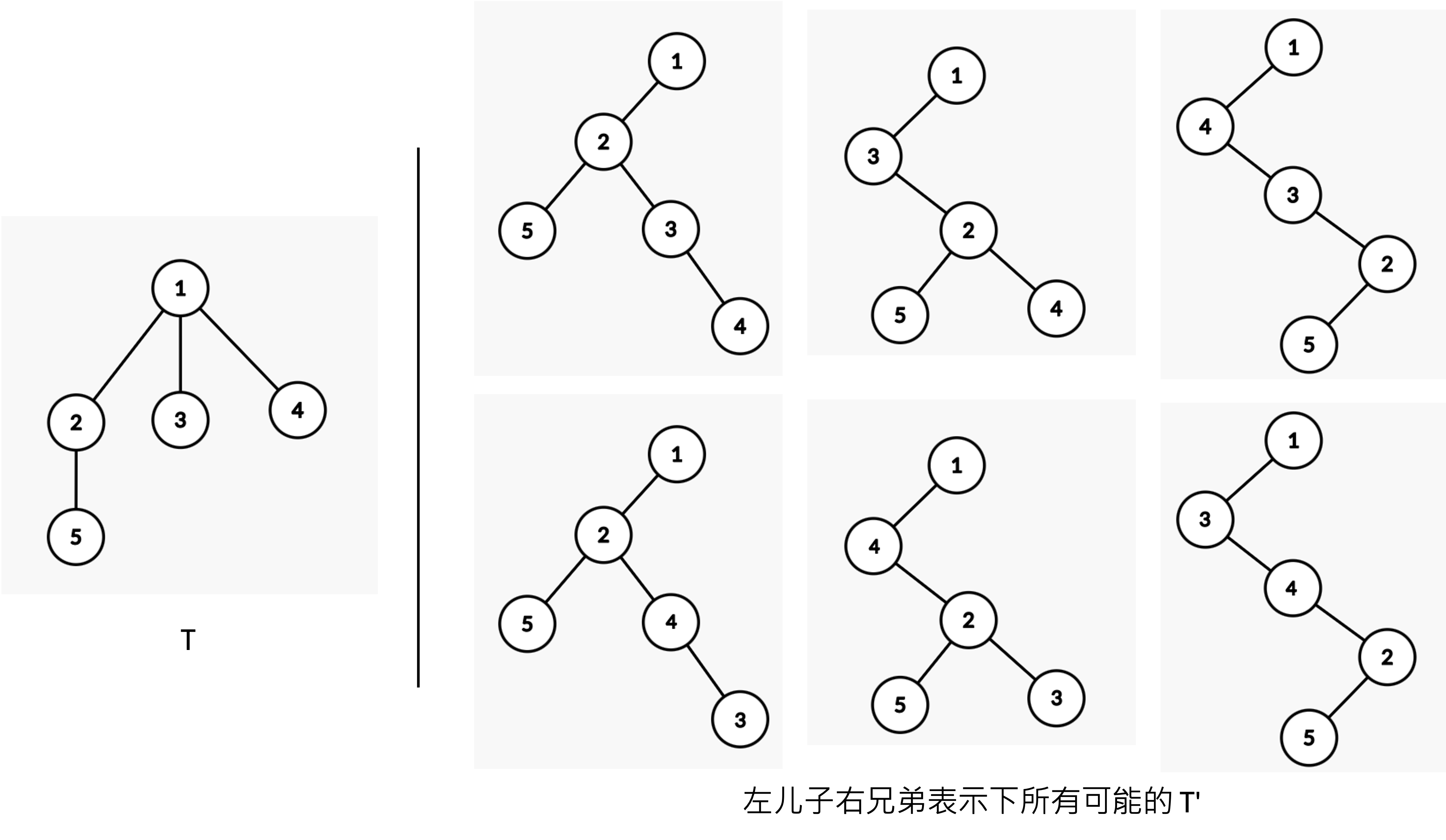
All possible T' under the left-child right-sibling representation
- The sum of the subtree sizes of all nodes for the two trees $T'$ in the first column is $5 + 4 + 2 + 1 + 1 = 13$.
- The sum of the subtree sizes of all nodes for the two trees $T'$ in the second column is $5 + 3 + 4 + 1 + 1 = 14$.
- The sum of the subtree sizes of all nodes for the two trees $T'$ in the third column is $5 + 2 + 3 + 4 + 1 = 15$.