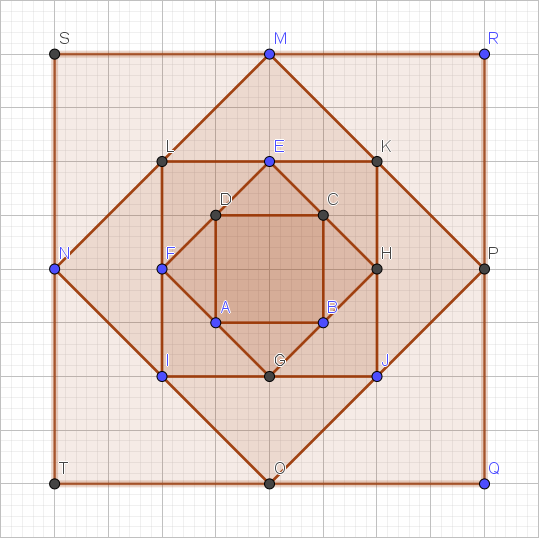
As shown in the figure below, first draw a square with side length 1, then draw a second square circumscribed around it such that the four vertices of the original square lie exactly on the midpoints of the sides of the new square. Continuing this process, the vertices of the $i$-th square lie exactly on the midpoints of the sides of the $(i+1)$-th square. Please find the side length of the $n$-th square drawn.
Input
This problem contains multiple test cases. The first line contains an integer $T$ ($1 \le T \le 50$). For each test case, the input contains a single integer $n$ ($1 \le n \le 50$).
Output
For each test case, output a single decimal number representing the side length of the $n$-th square, rounded to two decimal places.
Examples
Input 1
2
1
2
Output 1
1.00
1.41