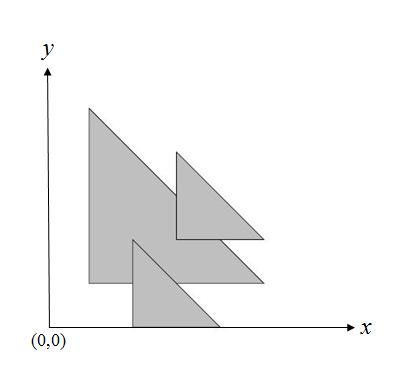
In a two-dimensional plane, you are given $N$ isosceles right triangles (each triangle has its two legs parallel to the coordinate axes, and the hypotenuse runs from top-left to bottom-right). We describe such a triangle using three non-negative integers $(x, y, d)$, where the coordinates of the three vertices of the triangle are $(x, y)$, $(x + d, y)$, and $(x, y + d)$. Calculate the total area covered by these $N$ triangles. For example, the figure below shows 3 triangles, and the total covered area is $11.0$.
Input
The first line contains a positive integer $N$, representing the number of triangles. Each of the following $N$ lines contains three space-separated non-negative integers $x, y, d$, describing the vertex coordinates of a triangle as $(x, y)$, $(x + d, y)$, and $(x, y + d)$, where $0 \le x, y, d \le 1000000$. For 50% of the data, $1 \le N \le 500$; for 100% of the data, $1 \le N \le 10000$.
Output
Output a single line containing a real number $S$, representing the total area covered by all triangles, rounded to exactly one decimal place. The input data guarantees $S \le 2^{31}$.
Examples
Input 1
3
1 1 4
2 0 2
3 2 2
Output 1
11.0