In a directed graph $G$, every edge has a length of $1$. Given a starting point and an ending point, find a path from the start to the end that satisfies the following conditions:
- For every vertex on the path, all vertices reachable from its outgoing edges must be directly or indirectly connected to the ending point.
- Among paths satisfying condition 1, find the shortest one.
Note: The graph $G$ may contain multiple edges and self-loops. It is guaranteed that the ending point has no outgoing edges.
Output the length of the path that satisfies these conditions.
Input
The first line contains two space-separated integers $n$ and $m$, representing the number of vertices and edges in the graph.
The next $m$ lines each contain two space-separated integers $x$ and $y$, representing a directed edge from vertex $x$ to vertex $y$.
The last line contains two space-separated integers $s$ and $t$, representing the starting point $s$ and the ending point $t$.
Output
Output a single integer representing the length of the shortest path satisfying the problem description. If no such path exists, output $-1$.
Examples
Input 1
3 2
1 2
2 1
1 3
Output 1
-1
Note 1
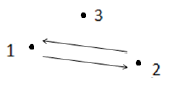
As shown in the figure above, arrows represent directed roads and dots represent cities. The starting point $1$ is not connected to the ending point $3$, so no path satisfying the conditions exists; therefore, output $-1$.
Input 2
6 6
1 2
1 3
2 6
2 5
4 5
3 4
1 5
Output 2
3
Note 2
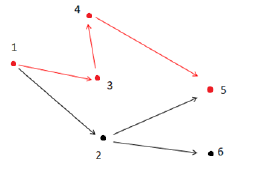
As shown in the figure above, the path satisfying the conditions is $1 \to 3 \to 4 \to 5$. Note that vertex $2$ cannot be part of the answer path because vertex $2$ has an outgoing edge to vertex $6$, and vertex $6$ is not connected to the ending point $5$.
Constraints
For 30% of the data, $0 < n \le 10$, $0 < m \le 20$;
For 60% of the data, $0 < n \le 100$, $0 < m \le 2000$;
For 100% of the data, $0 < n \le 10000$, $0 < m \le 200000$, $0 < x, y, s, t \le n$, $x, s \ne t$.