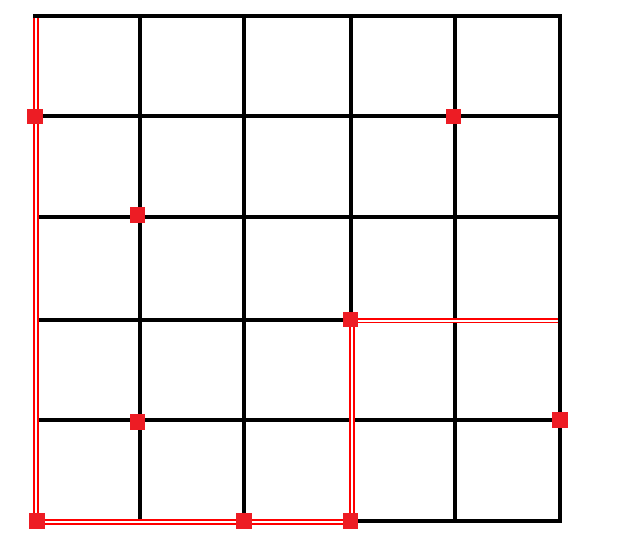
In 2046, the urban rail transit construction in OI City was finally completed. Due to meticulous early planning, the completed rail network consists of $2n$ subway lines, forming a grid of $n$ vertical and $n$ horizontal lines. As shown in the figure below, each of these $2n$ lines contains $n$ stations, and every station is located at the intersection of one horizontal and one vertical line.
Due to construction costs, not every station allows for in-station transfers. There are $m$ subway stations where in-station transfers are possible. In the figure below, stations marked with a square are transfer stations. It is known that traveling between two adjacent stations on a line takes $2$ minutes, and an in-station transfer takes $1$ minute. Serenade wants to know the minimum time required to travel from school to home without exiting the station network (waiting time for trains is ignored).
Input
The first line contains two integers $n$ and $m$.
The next $m$ lines each contain two integers $x$ and $y$, indicating that the intersection of the $x$-th horizontal line and the $y$-th vertical line is a transfer station.
The last line contains four integers $x_1, y_1, x_2, y_2$. This indicates that Serenade boards the train at the intersection of the $x_1$-th horizontal line and the $y_1$-th vertical line, and gets off at the intersection of the $x_2$-th horizontal line and the $y_2$-th vertical line.
Output
Output a single line containing the minimum time required for Serenade to get home by choosing the lines reasonably. If Serenade cannot get home without exiting the station network, output -1.
Examples
Input 1
2 1
1 2
1 1 2 2
Output 1
5
Input 2
6 9
2 1
2 5
3 2
4 4
5 2
5 6
6 1
6 3
6 4
1 1 4 6
Output 2
27
Input 3
6 10
2 1
2 5
3 2
4 4
5 2
5 6
6 1
6 3
6 4
6 6
1 1 4 6
Output 3
26
Subtasks
For $30\%$ of the data, $n\le 50$, $m\le 1\,000$;
For $60\%$ of the data, $n\le 500$, $m\le 2\,000$;
For $100\%$ of the data, $n\le 20\,000$, $m\le 100\,000$;