Mom bought Vasya an $n$-dimensional chocolate bar, which is an $n$-dimensional cube with each side length equal to $1$. The chocolate is marked for division into segments. Along the $i$-th dimension, it can be divided by hyperplanes into $a_i$ equal parts. Thus, the chocolate is divided into a total of $a_1 \cdot a_2 \cdot \dots \cdot a_n$ segments, where the length of each segment along the $i$-th dimension is $\frac{1}{a_i}$, and consequently, the volume of each segment is $\frac{1}{a_1 a_2 \dots a_n}$.
Vasya and his friends want to cut the chocolate to obtain at least $k$ pieces, while maximizing the volume of the smallest piece. The chocolate can only be cut at the boundaries of the segments, and each cut must pass through the entire chocolate along a hyperplane involved in the formation of the segments. Only after making all the cuts does Vasya break the chocolate into pieces.
More formally, Vasya wants to choose numbers $b_1, b_2, \dots, b_n$ ($1 \le b_i \le a_i$) — the number of parts into which Vasya will cut the chocolate along each dimension. The condition $b_1 \cdot b_2 \cdot \dots \cdot b_n \ge k$ must be satisfied to obtain at least $k$ pieces after all cuts. It can be noted that with an optimal cutting strategy using these parameters, the smallest piece will contain $\frac{a_1}{b_1} \cdot \dots \cdot \frac{a_n}{b_n}$ segments, and its volume will be equal to $\left( \frac{a_1}{b_1} \cdot \dots \cdot \frac{a_n}{b_n} \right) \cdot \frac{1}{a_1 a_2 \dots a_n}$.
Vasya wants to obtain the maximum possible value of the volume of the smallest piece multiplied by $k$, that is, he wants to maximize the number $\left( \frac{a_1}{b_1} \cdot \dots \cdot \frac{a_n}{b_n} \right) \cdot \frac{1}{a_1 a_2 \dots a_n} \cdot k$. Help him with this.
Input
The first line contains two integers $n$ and $k$ ($1 \le n \le 100$, $1 \le k \le 10^7$) — the dimension of the chocolate and the number of pieces it needs to be divided into.
The second line contains $n$ integers $a_1, a_2, \dots, a_n$ ($1 \le a_i \le 10^7$) — the number of segments into which the chocolate is marked along each dimension.
Output
Output a single number — the maximum possible volume of the smallest piece obtained, multiplied by $k$, with an absolute or relative error of no more than $10^{-9}$.
If it is impossible to cut the chocolate into at least $k$ pieces under the given constraints, output $0$.
Examples
Input 1
1 2
5
Output 1
0.8
Input 2
2 6
5 10
Output 2
0.72
Input 3
2 7
4 4
Output 3
0.875
Input 4
2 3
4 5
Output 4
0.75
Input 5
4 444
57 179 239 2
Output 5
0.97557326850704739751
Input 6
2 5
2 2
Output 6
0
Note
In the first example, a one-dimensional chocolate bar can be divided as follows: Then the answer is $\frac{2}{5} \cdot 2 = 0.8$.
In the second example, the chocolate can be cut as follows: Then the answer is $\frac{2}{5} \cdot \frac{3}{10} \cdot 6 = 0.72$.
In the third example, the chocolate can be cut as follows: Then the answer is $\frac{2}{4} \cdot \frac{1}{4} \cdot 7 = 0.875$.
Subtasks
| Group | Points | Additional Constraints | Required Groups | Comment |
|---|---|---|---|---|
| 0 | 0 | - | - | Sample tests. |
| 1 | 10 | $n \le 2$ | - | |
| 2 | 12 | $k \le 500$, $a_i \le 500$ | 0 | |
| 3 | 13 | $k \le 20\,000$, $a_i \le 2000$ | 0, 2 | |
| 4 | 12 | $k \le 40\,000$ | 0, 2, 3 | |
| 5 | 10 | $k \le 200\,000$ | 0, 2, 3, 4 | |
| 6 | 11 | $k \le 4 \cdot 10^6$, $a_i \le 2000$ | 0, 2, 3 | |
| 7 | 15 | $k \le 5 \cdot 10^6$ | 0, 2 - 6 | |
| 8 | 17 | - | 0 - 7 | Offline testing. |
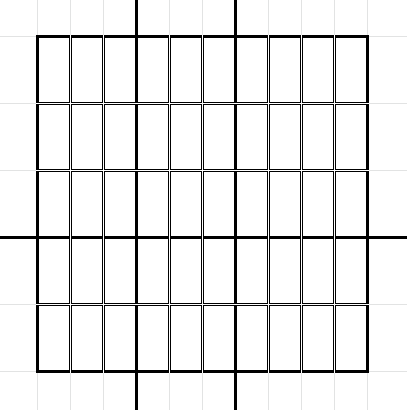
Figure 1. One-dimensional chocolate bar division