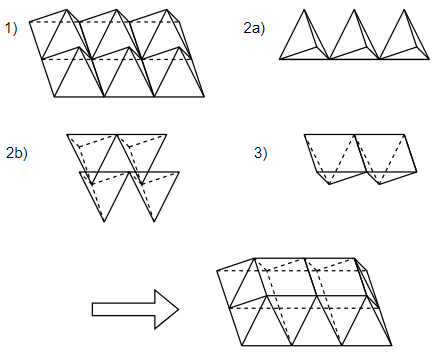
Coco has an infinite supply of uniquely shaped white and dark chocolates. The white chocolates are square pyramids with side lengths of $1$, and the dark chocolates are regular tetrahedra with side lengths of $1$. One day, while playing with these chocolates, Coco discovered that by stacking them properly, one can build a larger square pyramid. The specific method for building a pyramid with a base of size $R \times C$ is as follows:
- First, fill the base with $R \times C$ white chocolates.
- Fill the spaces between the white chocolates with dark chocolates.
- Fill the spaces between the dark chocolates with white chocolates. After this step, the top surface becomes a flat rectangle of size $(R-1) \times (C-1)$.
- Repeat this process until the area of the top surface becomes $0$.
The image below shows the process of filling the first layer of a $2 \times 3$ pyramid. Filling the first layer requires 8 white chocolates and 7 dark chocolates, and including the second layer requires a total of 10 white chocolates and 8 dark chocolates.
Coco wants to build a very large chocolate pyramid as a gift for Hanbyeol. Calculate how many white and dark chocolates are needed.
Input
The first line contains the number of test cases $T$. Each of the following $T$ lines contains two integers $R$ and $C$ in order.
Output
For each test case, output the number of white chocolates and dark chocolates required, separated by a space.
Examples
Input 1
2
2 3
10 10
Output 1
10 8
670 660
Note
$1 \le T \le 10^5$, $1 \le R, C \le 10^6$