Keke is a girl who loves data structures. Among common data structures, her favorite is the segment tree.
The core of a segment tree is the lazy tag. Below is the pseudocode for a segment tree with lazy tags, where the tag array stores the lazy tags:
1: function Pushdown(Node)
2: if tag[Node]= 1 then
3: tag[Lson(Node)]← 1
4: tag[Rson(Node)]← 1
5: tag[Node]← 0
6: end if
7: end function
8:
9: function Modify(Node, l, r, ql, qr)
10: if [l, r] ∩ [ql, qr] = ∅ then
11: return
12: end if
13: if [l, r] ⊆ [ql, qr] then
14: tag[Node] ← 1
15: return
16: end if
17: m ← ⌊(l + r) / 2⌋
18: Pushdown(Node)
19: Modify(Lson(Node),l, m, ql, qr)
20: Modify(Rson(Node),m + 1, r, ql, qr)
21: end function
Here, the function Lson(Node) represents the left child of Node, and Rson(Node) represents the right child of Node.
Keke currently has a segment tree on $[1, n]$, numbered 1. All nodes in this segment tree have a tag of 0. Keke then performs $m$ operations of two types:
1 l r: Suppose Keke currently has $t$ segment trees. She will duplicate each segment tree twice (thetagarray is also copied). The two copies of the original segment tree $i$ are numbered $2i - 1$ and $2i$. After the duplication, Keke has a total of $2t$ segment trees. Then, Keke performsModify(root, 1, n, l, r)on all segment trees with odd numbers.2: Keke defines the weight of a segment tree as the number of nodes in it that have atagof 1. Keke wants to know the sum of the weights of all the segment trees she currently has.
Input
The first line contains two integers $n, m$, representing the initial interval length and the number of operations.
The next $m$ lines each describe an operation. It is guaranteed that $1 \le l \le r \le n$.
Output
For each query, output a single integer representing the answer. Since the answer can be very large, output it modulo 998244353.
Examples
Input 1
5 5
2
1 1 3
2
1 3 5
2
Output 1
0
1
6
Note
The segment tree on $[1, 5]$ is shown below:
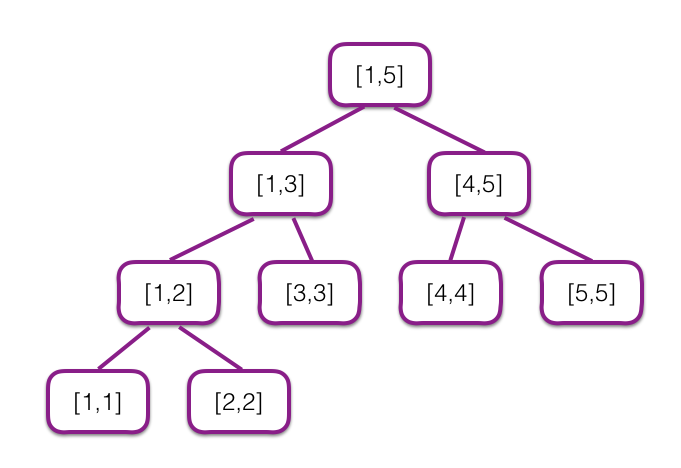
At the first query, Keke has one segment tree, and none of its nodes have a tag, so the answer is 0.
At the second query, Keke has two segment trees. According to their numbering, their tag status is:
- Node $[1, 3]$ has a tag, weight is 1.
- No nodes have a tag, weight is 0.
Therefore, the answer is 1.
At the third query, Keke has four segment trees. According to their numbering, their tag status is:
- Nodes $[1, 2], [3, 3], [4, 5]$ have tags, weight is 3.
- Node $[1, 3]$ has a tag, weight is 1.
- Nodes $[3, 3], [4, 5]$ have tags, weight is 2.
- No nodes have a tag, weight is 0.
Therefore, the answer is 6.