There are $n$ closed intervals $[l_1, r_1], [l_2, r_2], \dots, [l_n, r_n]$ on the number line. You need to select $m$ intervals from these such that these $m$ intervals share at least one common position. In other words, there must exist an $x$ such that for every selected interval $[l_i, r_i]$, we have $l_i \le x \le r_i$.
For a valid selection, the cost is defined as the length of the longest selected interval minus the length of the shortest selected interval. The length of an interval $[l_i, r_i]$ is defined as $r_i - l_i$, which is the value of its right endpoint minus the value of its left endpoint.
Find the minimum cost among all valid selection schemes. If no valid scheme exists, output $-1$.
Input
The first line contains two positive integers $n$ and $m$, separated by a space, as described above. It is guaranteed that $1 \le m \le n$.
The next $n$ lines each represent an interval, containing two integers $l_i$ and $r_i$ separated by a space, representing the left and right endpoints of the interval.
Output
Output a single line containing a single integer, the minimum cost.
Examples
Input 1
6 3
3 5
1 2
3 4
2 2
1 5
1 4
Output 1
2
Note
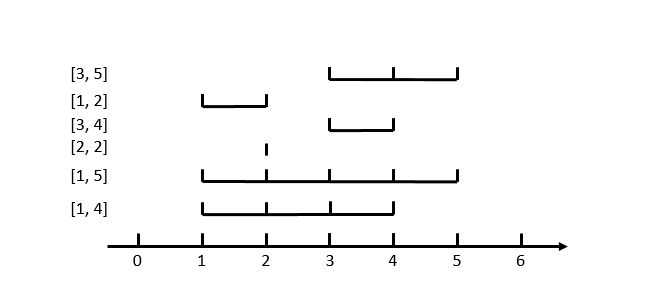
As shown in the figure, when $n = 6$ and $m = 3$, the scheme with the minimum cost is to select the three intervals $[3, 5]$, $[3, 4]$, and $[1, 4]$. They all contain the position $4$, so it is valid. The longest interval is $[1, 4]$ and the shortest is $[3, 4]$, so the cost is $(4 - 1) - (4 - 3) = 2$.
Input 2
See interval/interval2.in in the contestant directory.
Output 2
See interval/interval2.ans in the contestant directory.
Input 3
See interval/interval3.in in the contestant directory.
Output 3
See interval/interval3.ans in the contestant directory.
Subtasks
The ranges and characteristics of all test data are shown in the table below:
| Test Case ID | $n$ | $m$ | $l_i, r_i$ |
|---|---|---|---|
| 1 | 20 | 9 | $0 \le l_i \le r_i \le 100$ |
| 2 | 20 | 10 | $0 \le l_i \le r_i \le 100$ |
| 3 | 199 | 3 | $0 \le l_i \le r_i \le 100000$ |
| 4 | 200 | 3 | $0 \le l_i \le r_i \le 100000$ |
| 5 | 1000 | 2 | $0 \le l_i \le r_i \le 100000$ |
| 6 | 2000 | 2 | $0 \le l_i \le r_i \le 100000$ |
| 7 | 199 | 60 | $0 \le l_i \le r_i \le 5000$ |
| 8 | 200 | 50 | $0 \le l_i \le r_i \le 5000$ |
| 9 | 200 | 50 | $0 \le l_i \le r_i \le 10^9$ |
| 10 | 1999 | 500 | $0 \le l_i \le r_i \le 5000$ |
| 11 | 2000 | 400 | $0 \le l_i \le r_i \le 5000$ |
| 12 | 2000 | 500 | $0 \le l_i \le r_i \le 10^9$ |
| 13 | 30000 | 2000 | $0 \le l_i \le r_i \le 100000$ |
| 14 | 40000 | 1000 | $0 \le l_i \le r_i \le 100000$ |
| 15 | 50000 | 15000 | $0 \le l_i \le r_i \le 100000$ |
| 16 | 100000 | 20000 | $0 \le l_i \le r_i \le 100000$ |
| 17 | 200000 | 20000 | $0 \le l_i \le r_i \le 10^9$ |
| 18 | 300000 | 50000 | $0 \le l_i \le r_i \le 10^9$ |
| 19 | 400000 | 90000 | $0 \le l_i \le r_i \le 10^9$ |
| 20 | 500000 | 200000 | $0 \le l_i \le r_i \le 10^9$ |