生日悖论(Birthday Paradox)是一个令人惊讶的事实:如果一个群体中有 23 个人,那么其中至少有两个人生日相同的概率超过 50%。其背后的假设是:所有生日出现的概率相等(这并不完全正确),一年恰好有 365 天(这也不完全正确),且群体中的人是均匀随机选择的(这是一个有些奇怪的前提)。对于本题,我们将接受这些假设。
考虑如果我们随机选择 $P = 10$ 个人的群体,我们可能会观察到什么。一旦选定了一个群体,我们根据共享的生日将他们分成若干子组。在许多其他可能性中,我们可能会观察到以下关于共享生日的分布:
- 所有 10 个人的生日都不同,或者
- 所有 10 个人的生日都相同,或者
- 3 个人有相同的生日,另外 2 个人有相同的生日(在不同的一天),其余 5 个人生日各不相同。
当然,这些分布发生的概率各不相同。
你的任务是计算给定生日共享分布的概率。也就是说,如果一个群体中有 $P$ 个人,那么给定生日共享分布的概率是多少(在所有 $P$ 个人均匀随机选择的可能分布中)?
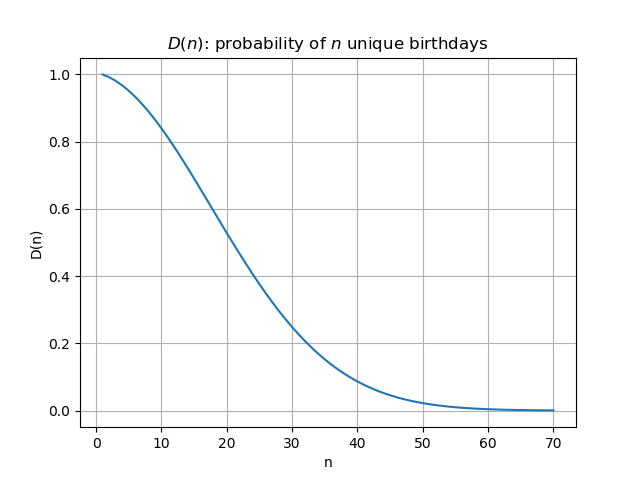
n 个人中出现 n 个唯一生日的概率。
输入格式
第一行给出一个数字 $n$,其中 $1 \le n \le 365$。第二行包含整数 $c_1$ 到 $c_n$,其中对于所有 $c_i$ 满足 $1 \le c_i \le 100$。值 $c_i$ 表示共享某个特定生日的人数(且该生日与群体中其他人的生日不同)。
输出格式
计算观察到具有给定共享生日分布的群体的概率 $b$。由于 $b$ 可能非常小,请输出 $\log_{10}(b)$。如果你的答案与裁判答案的绝对误差或相对误差不超过 $10^{-6}$,则视为正确。
说明
第一个样例展示了 $P = 2$ 个人且生日各不相同的情况。这种情况发生的概率为 $b = 364/365 \approx 0.9972602740$,且 $\log_{10}(b) \approx -0.001191480807419$。
第二个样例代表了前面列表中提到的第三个例子,其中 $P = 10$ 个人。在这种情况下,概率为 $b \approx 0.0000489086$,且 $\log_{10}(b) \approx -4.310614508857128$。
样例
输入 1
2
1 1
输出 1
-0.001191480807419
输入 2
7
1 1 2 1 3 1 1
输出 2
-4.310614508857128