In a Cartesian coordinate system, Wayne needs you to perform $n$ operations of two types:
0 x y: Add a circle to the coordinate system with center $(x, y)$ that passes through the origin.1 x y: Query whether the point $(x, y)$ is inside (or on the boundary of) all circles added so far, and at least inside (or on the boundary of) one circle.
To simplify your task, it is guaranteed that the centers of the circles are strictly above the $x$-axis (positive $y$-coordinate) and have non-zero $x$-coordinates.
Input
The first line contains an integer $n$.
The next $n$ lines each start with an integer $0$ or $1$, representing the two types of operations.
This is followed by two real numbers $x$ and $y$, the meanings of which are described above.
Output
For each query operation, output "Yes" if the point is inside (or on the boundary of) all circles added so far; otherwise, output "No".
Examples
Input 1
5
0 2.0000 3.0000
0 4.0000 1.0000
1 1.000000 1.000000
0 -3.0000 2.0000
1 1.000000 1.000000
Output 1
Yes
No
Note
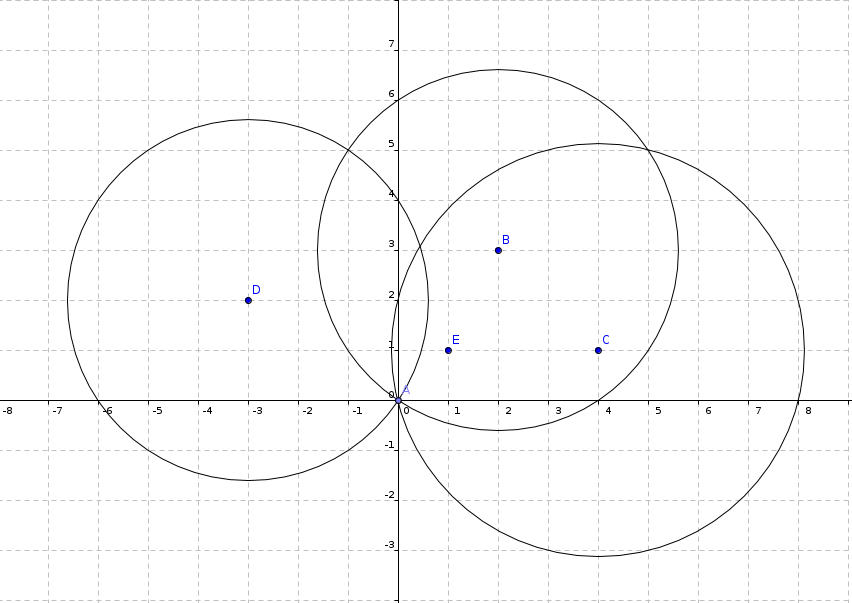
As shown in the figure, when the first query is made, circle D has not been added yet, and E is inside circles B and C; when the second query is made, E is not inside circle D.
Constraints
For $30\%$ of the data, $n \leq 1\,000$.
For $40\%$ of the data, the input data can be considered as uncorrelated random numbers.
For another $20\%$ of the data, $n \leq 100\,000$, and the intersection region of the circles will not consist of more than $20$ circular arcs.
For $100\%$ of the data, $n \leq 500\,000$, and the absolute values of all coordinates do not exceed $10\,000$.
The input data guarantees that the $y$-coordinates of the circle centers are positive and the $x$-coordinates are non-zero.
Circle center coordinates are provided with $4$ decimal places, and query point coordinates are provided with $6$ decimal places. Please be careful with precision control.