In chess, the king is the most important piece. In each step, the king can move one square horizontally, vertically, or diagonally, as shown in the figure below.
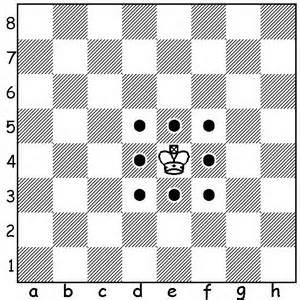
Given two squares $A(r1, c1)$ and $B(r2, c2)$, your task is to calculate the minimum number of steps a king needs to travel from $A$ to $B$. To make the problem less trivial, we have removed a square $C(r3, c3)$ from the board (it is guaranteed that $A$, $B$, and $C$ are distinct), and the king is not allowed to enter square $C$ while moving from $A$ to $B$. In this problem, rows are numbered 1 to 8 from top to bottom, and columns are numbered 1 to 8 from left to right.
Input
The input contains no more than 10,000 test cases. Each test case contains 6 integers $r1, c1, r2, c2, r3, c3$ ($1 \le r1, c1, r2, c2, r3, c3 \le 8$). It is guaranteed that the three squares $A, B, C$ are distinct.
Output
For each test case, output the test case number and the minimum number of steps.
Examples
Input 1
1 1 8 7 5 6
1 1 3 3 2 2
Output 1
Case 1: 7
Case 2: 3