In a two-dimensional space, given a convex polygon with a surface density of $\rho$, it is placed into an infinite pool of water with a horizontal surface at $y=0$ and a water density of $1$. Find the counter-clockwise rotation angle of the convex polygon when it is at rest and its potential energy reaches its minimum.
The potential energy includes the gravitational potential energy of the convex polygon itself and the buoyancy potential energy generated by the work done by buoyancy.
Input
The first line contains an integer $N$, representing the number of test cases. For each test case: The first line contains an integer $n$ and a floating-point number $\rho$, representing the number of vertices of the polygon and the density of the polygon, respectively. The next $n$ lines each contain two floating-point numbers $x, y$, representing the vertices of the convex hull in counter-clockwise order.
Output
For each test case, output a single line containing $\theta$, the counter-clockwise rotation angle in radians when the convex polygon reaches its minimum potential energy, where $0 \leq \theta < 2\pi$.
This problem uses a Special Judge. An error of $10^{-6}$ is allowed for your output. Please output as many decimal places as possible (but do not exceed 15 decimal places).
Examples
Input 1
3
3 0.3
0.23272177 0.50274749
0.69314977 0.57621227
0.63404493 0.80356643
7 0.7
0.97651045  0.03790015
0.9919297   0.75416081
0.76345204  0.83482219
0.17087067  0.83086959
0.19621027  0.49532965
0.24676201  0.45389929
0.67563998  0.14424922
8 0.6
0.03726264  0.10180906
0.50450581  0.13303585
0.81055071  0.29025366
0.99405094  0.68868719
0.77510244  0.87181985
0.40531889  0.91965237
0.27990499  0.84662178
0.07581749  0.30329282
Output 1
2.60634462
3.83816499
2.50530629
Note
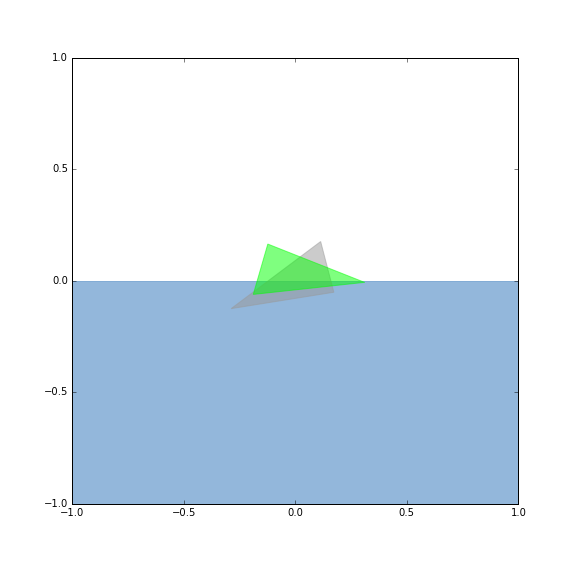
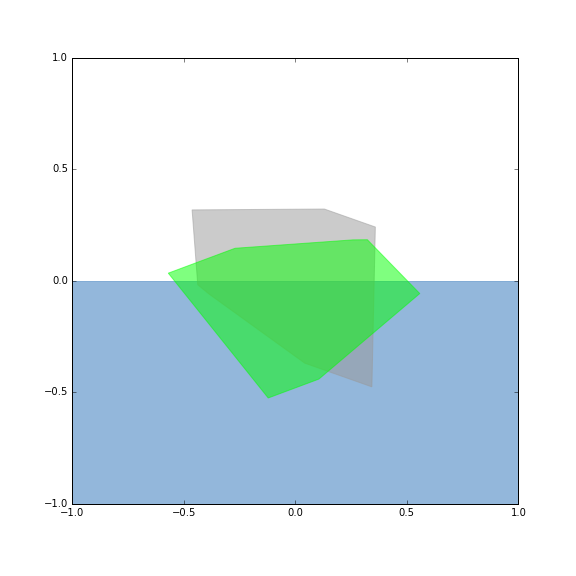
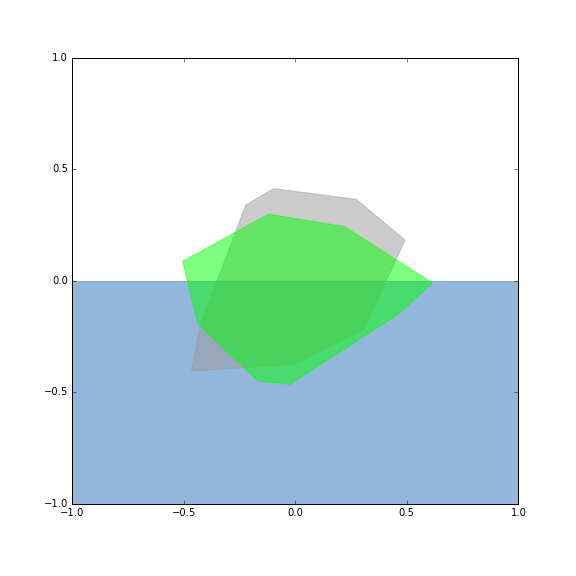
The visualizations for the three data sets above are as follows:
- Green represents the shape of the polygon at rest with minimum energy,
- Gray represents the original polygon,
- Blue represents the water surface.
Constraints
The convex polygon is given in counter-clockwise order.
The number of test cases $N \leq 10$.
$0.1 < \rho < 0.9$.
$0 \leq x, y \leq 1$.
For 30% of the data, $n=3$.
For 60% of the data, $n \leq 100$.
For 100% of the data, $n \leq 100000$, $\sum n \leq 100000$.
The data is guaranteed to form a convex polygon, the distance between any two adjacent points on the polygon is at least $10^{-10}$, and the area of the polygon is at least $10^{-4}$.
The data is guaranteed to have a unique solution.