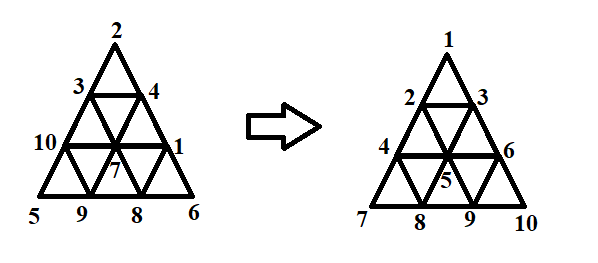
The image above shows a grid of size $N \times M$. Each cell $(i, j)$ (where $1 \le i \le N$ and $1 \le j \le M$) contains a non-negative integer $A_{i, j}$.
You start at cell $(1, 1)$ and want to reach cell $(N, M)$. In each step, you can move to an adjacent cell (up, down, left, or right). You cannot visit the same cell more than once in a single path.
Let the sequence of cells visited be $(r_1, c_1), (r_2, c_2), \dots, (r_k, c_k)$, where $(r_1, c_1) = (1, 1)$ and $(r_k, c_k) = (N, M)$. The cost of the path is defined as the bitwise XOR sum of the values in the visited cells: $A_{r_1, c_1} \oplus A_{r_2, c_2} \oplus \dots \oplus A_{r_k, c_k}$.
Find the maximum possible cost of a path from $(1, 1)$ to $(N, M)$.
Input
The first line contains two integers $N$ and $M$ ($1 \le N, M \le 5$).
The next $N$ lines each contain $M$ integers, representing the grid $A$. Each $A_{i, j}$ satisfies $0 \le A_{i, j} \le 10^9$.
Output
Output a single integer representing the maximum possible XOR sum.
Examples
Input 1
2 2
1 2
4 8
Output 1
15
Input 2
3 3
1 0 0
0 0 0
0 0 1
Output 2
1