A key is a string of length $n = 2k+1$ containing $1$ letter X, $k$ letters A, and $k$ letters B. For example, when $k=3$, BAXABAB is a key.
As shown in the figure below, these $2k+1$ letters can be arranged in a circle in clockwise order:
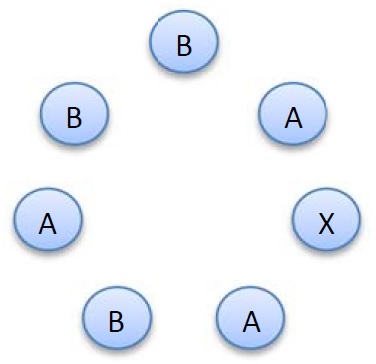
Among the $k$ letters A, some can be defined as "strong".
Specifically, starting from X and moving clockwise to a certain A, if the number of A's encountered is strictly greater than the number of B's encountered along the way, then this letter A is called strong.
For the example above, the $1$st and $2$nd letters A encountered clockwise from X are strong, while the $3$rd letter A is not strong.
The characteristic value of a key is the number of strong letters A it contains.
A genius child, KT, provided the following conclusion:
Suppose the positions of the $k$ letters A are fixed, but the positions of the remaining $k$ letters B and $1$ letter X are unknown. (Note that there are $k+1$ such keys, because there are $k+1$ possible positions for the letter X.)
It can be proven that the characteristic values of all these $k+1$ possible keys are distinct, and they are exactly $0, 1, 2, \dots, k$.
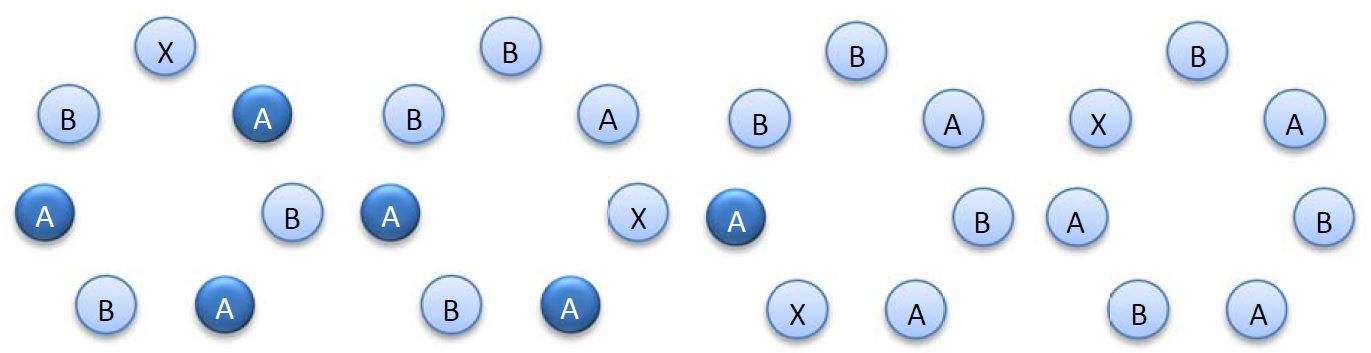
The figure on the next page shows a specific example, where the four sub-figures from left to right have $3, 2, 1, 0$ letters A that are strong, respectively.
Similarly, if the positions of the $k$ letters B are fixed, the characteristic values of all $k+1$ keys satisfying the condition are also distinct, and are exactly $0, 1, \dots, k$.
Now you need to solve the following three problems:
- Given the positions of all A's in the key, find the position of X when the characteristic value of the key is $0$.
- Given the positions of all A's in the key, find the position of X when the characteristic value of the key is $S$.
- Given the positions of all B's in the key, find the position of X when the characteristic value of the key is $S$.
Note: The positions of the $2k+1$ letters in the string are numbered from $1$ to $2k+1$.
Examples
Suppose $k=3, S=2$. Then:
When the positions of A are $\{2, 4, 6\}$ and the characteristic value is $0$, the position of X is $7$;
When the positions of A are $\{2, 4, 6\}$ and the characteristic value is $2$, the position of X is $3$;
When the positions of B are $\{2, 4, 6\}$ and the characteristic value is $2$, the position of X is $5$.
Suppose $k=9, S=7$. Then:
When the positions of A are $\{3, 4, 5, 9, 10, 12, 13, 16, 19\}$ and the characteristic value is $0$, the position of X is $14$;
When the positions of A are $\{3, 4, 5, 9, 10, 12, 13, 16, 19\}$ and the characteristic value is $7$, the position of X is $18$;
When the positions of B are $\{3, 4, 5, 9, 10, 12, 13, 16, 19\}$ and the characteristic value is $7$, the position of X is $17$.
Input
The input contains only one test case.
The first line contains an integer $k$, as described in the problem.
The second line contains an integer $seed$, which will be used to generate a set $P$ of size $k$.
The third line contains an integer $S$, as described in the problem.
It is guaranteed that $0 \le S \le k \le 10^7$ and $1 \le seed \le 10000$.
The provided files include three files cipher.cpp/c/pas for generating the input data. The reading part is already completed; in the array $p[]$, if $p[i] = 0$, it means $i$ does not belong to set $P$, otherwise, $i$ belongs to set $P$.
Output
Output three lines, each containing one number, corresponding to the answers to the three sub-problems described in the problem statement.
That is:
- The first number represents the position of X when the $k$-element set $P$ represents the positions of A and the characteristic value is $0$.
- The second number represents the position of X when the $k$-element set $P$ represents the positions of A and the characteristic value is $S$.
- The third number represents the position of X when the $k$-element set $P$ represents the positions of B and the characteristic value is $S$.
Examples
Input 1
5
3344
2
Output 1
10
1
2
Note 1
In the first example, the indices of elements where the $P$ array is $1$ are $5, 6, 7, 8, 9$.
Input 2
500000
4545
234567
Output 2
999992
246922
753067
Constraints
For $30\%$ of the data, $k \le 10^3$.
For $50\%$ of the data, $k \le 10^5$.
For $100\%$ of the data, $k \le 10^7$.
For each test point, the score is the sum of the scores of the following three parts:
- If the first question is answered correctly, you will receive $3$ points.
- If the second question is answered correctly, you will receive $4$ points.
- If the third question is answered correctly, you will receive $3$ points.
If you only know part of the answers, please still output three numbers according to this format. Otherwise, you may not receive any points due to formatting errors.