As is well known, Christmas in the year 3202 is approaching, so Little $\Omega$ has bought a Christmas tree and a wire covered in fairy lights, and she intends to wrap this wire around the Christmas tree.
The Christmas tree can be viewed as a convex polygon with $n$ vertices in a two-dimensional plane. These $n$ vertices can be used to fix the wire, and they are numbered $1, \dots, n$ in clockwise order. The coordinates of the $i$-th vertex are $(x_i, y_i)$. Let $k$ be the index of the vertex with the maximum $y$-coordinate (if there are multiple such vertices, choose the one with the smallest index).
The left side of the figure below shows the outline of a Christmas tree, where the vertex with the maximum $y$-coordinate has index $k = 5$.
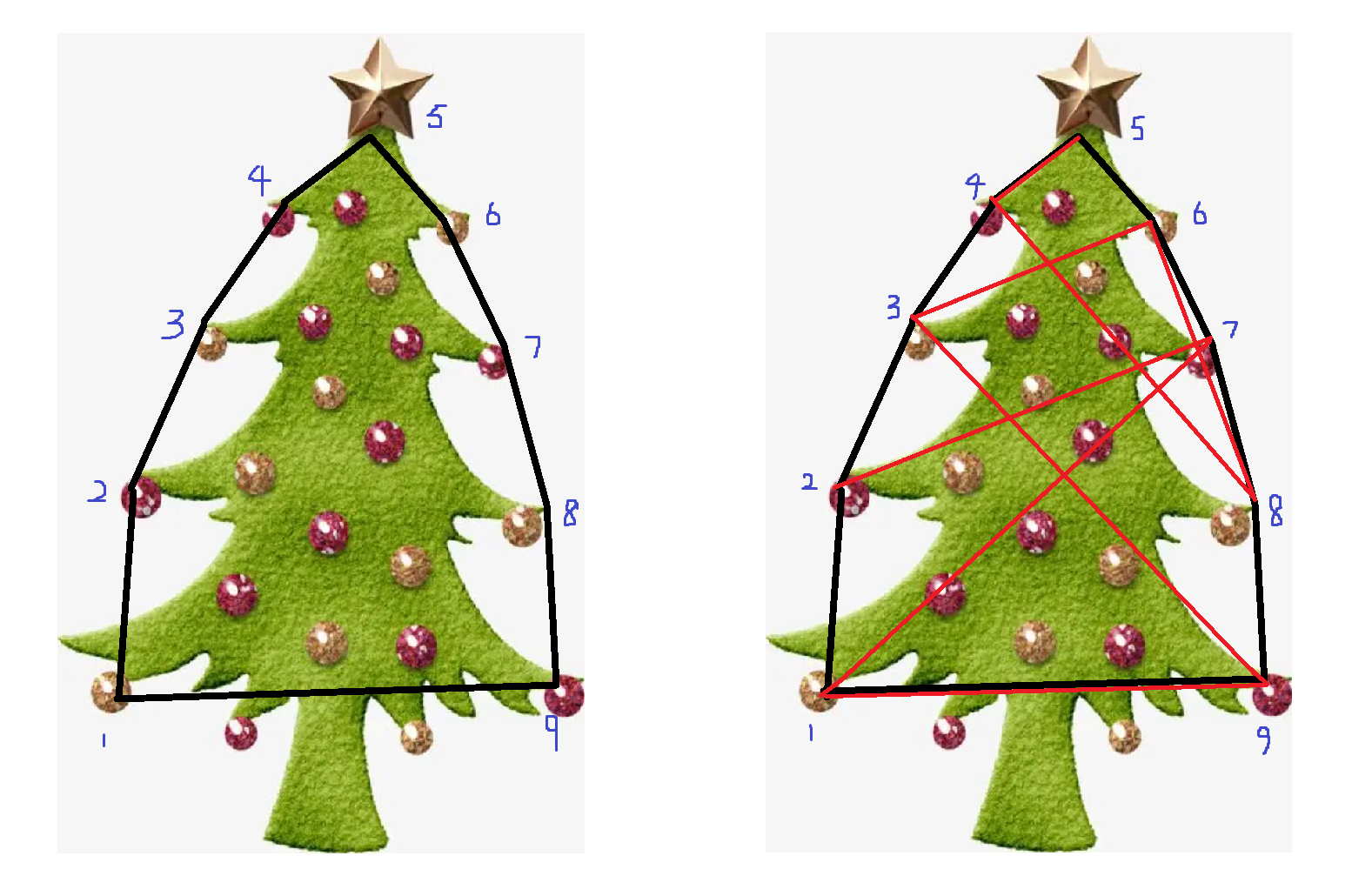
Figure 2: A Christmas tree and a possible wiring scheme
Little $\Omega$ wishes to decorate this Christmas tree with the wire covered in fairy lights. For aesthetic reasons, she wants the wire to pass through every vertex exactly once. To connect to the power source, the wire must start from $(x_k, y_k)$. Formally, she needs to determine a permutation $p_1, \dots, p_n$ of $1, \dots, n$ such that $p_1 = k$, and the wire starts from $(x_{p_1}, y_{p_1})$ and passes through $(x_{p_2}, y_{p_2}), \dots, (x_{p_n}, y_{p_n})$ in order. The length of the wire is then $\sum_{i=1}^{n-1} d((x_{p_i}, y_{p_i}), (x_{p_{i+1}}, y_{p_{i+1}}))$.
- Here, $d$ is the Euclidean distance in the plane, i.e., $d((x, y), (x', y')) = \sqrt{(x - x')^2 + (y - y')^2}$.
The right side of the figure above shows one possible scheme, where the corresponding permutation is $5, 4, 8, 6, 3, 9, 1, 7, 2$.
To save costs, she wants you to provide a scheme that minimizes the length of the wire among all possible schemes. If there is more than one scheme that results in the shortest wire length, you only need to output any one of them.
Considering the errors caused by floating-point numbers, your output scheme is considered correct if the relative or absolute error of the wire length compared to the optimal wire length does not exceed $10^{-10}$.
Input
The first line contains a positive integer $n$, representing the number of vertices of the Christmas tree.
The next $n$ lines each contain two real numbers $x_i, y_i$ with 9 decimal places, representing the coordinates of the vertex with index $i$.
The data guarantees that these $n$ points are distinct, and connecting them in the order $(x_1, y_1), (x_2, y_2), \dots, (x_n, y_n)$ forms a convex polygon.
Output
Output a single line containing $n$ positive integers $p_1, p_2, \dots, p_n$ separated by single spaces, representing a permutation of $1, \dots, n$ such that $p_1 = k$, and the wire length $\sum_{i=1}^{n-1} d((x_{p_i}, y_{p_i}), (x_{p_{i+1}}, y_{p_{i+1}}))$ is the shortest among all possible schemes. If there is more than one such scheme, output any one of them.
Examples
Input 1
3
0.000000000 0.000000000
3.000000000 0.000000000
1.000000000 1.000000000
Output 1
3 1 2
Note 1
In this example, there are only two possible schemes as shown in the figure below, corresponding to the permutations $3, 1, 2$ or $3, 2, 1$. The wire lengths are $3 + \sqrt{2}$ and $3 + \sqrt{5}$ respectively, and $3 + \sqrt{2} < 3 + \sqrt{5}$.
Therefore, the permutation corresponding to the answer is $3, 1, 2$.

Figure 3: All two possible schemes for Example 1
Input 2
See tree/tree2.in and tree/tree2.ans in the contestant directory.
Output 2
See tree/tree2.in and tree/tree2.ans in the contestant directory.
Input 3
See tree/tree3.in and tree/tree3.ans in the contestant directory.
Output 3
See tree/tree3.in and tree/tree3.ans in the contestant directory.
Input 4
See tree/tree4.in and tree/tree4.ans in the contestant directory. This data satisfies special property A.
Output 4
See tree/tree4.in and tree/tree4.ans in the contestant directory.
Input 5
See tree/tree5.in and tree/tree5.ans in the contestant directory. This data satisfies special property B.
Output 5
See tree/tree5.in and tree/tree5.ans in the contestant directory.
Input 6
See tree/tree6.in and tree/tree6.ans in the contestant directory.
Output 6
See tree/tree6.in and tree/tree6.ans in the contestant directory.
Constraints
For all data, it is guaranteed that $3 \le n \le 1000$; $|x_i|, |y_i| \le 10^7$.
| Test Case ID | $n \le$ | Special Property |
|---|---|---|
| 1, 2 | 4 | |
| 3, 4, 5, 6 | 9 | None |
| 7, 8, 9, 10, 11, 12 | 18 | |
| 13, 14 | $10^3$ | A |
| 15, 16 | $10^3$ | B |
| 17, 18, 19, 20 | $10^3$ | None |
Special Property A: It is guaranteed that there exists a positive integer $m \ge n$ such that the input $n$ vertices correspond to a contiguous segment of vertices of a regular $m$-gon.
Special Property B: It is guaranteed that $x_1 < x_2 < \dots < x_n$ and $y_1 > y_2 > \dots > y_n$.