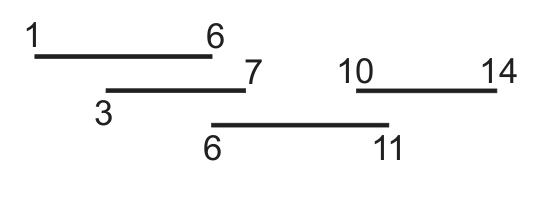
As usual, winter has caught the road crews by surprise. A blizzard is raging in Byteland, and the main road of Byteland urgently needs to be cleared of snow.
The crisis management team is responsible for the order and has $ m $ snowplows at its disposal, numbered from 1 to $ m $. Each plow is assigned a specific contiguous segment of the road to clear. Two segments may overlap, but no segment is entirely contained within another. The segments do not have to cover the entire length of the road (some parts of the road may run through tunnels and do not require clearing).
Unfortunately, a road workers' strike has just begun. The management of the crisis team has managed to convince only one plow operator to work, who has been entrusted with operating all the machines. Now, the order in which the plows are deployed must be determined. It has been ordered that each time, the worker will choose the plow that has the least amount of its assigned road segment left to clear (it is sufficient for each piece of the road to be cleared once, so a plow does not need to clear those parts that have already been cleared by other plows). In the event of a tie, the worker will choose the plow with the lower number.
Input
The first line of input contains two integers $ n $ and $ m $ ($ 1 \le n \le 10^{9} $, $ 1 \le m \le 300\,000 $), representing the length of the road and the number of plows. The next $ m $ lines describe the subsequent plows, with increasing numbers. The description of the $ i $-th plow consists of two integers $ a_{i} $, $ b_{i} $ ($ 1 \le a_{i} < b_{i} \le n $), representing the beginning and end of the road segment assigned to the $ i $-th plow. You may assume that $ a_{i} < a_{i+1} $, i.e., the plows are sorted by the beginning of their assigned road segment. Furthermore, no segment is entirely contained within another.
Output
Your program should output the numbers of the plows in the order they clear the road. The output should consist of $ m $ lines, each containing a single integer.
Examples
Input 1
15 4
1 6
3 7
6 11
10 14
Output 1
2
1
3
4
Note