Early in the morning, Bytazar sat comfortably on the pier by Lake Bytockie and indulged in his favorite hobby: fishing. At one point, he noticed that many fireflies were hovering over the calm surface of the lake. Bytazar liked this view so much that he decided to capture it in a photograph.
Photos taken with Bytazar's camera are square-shaped. Before taking the photo, Bytazar can set the camera at any height and move it left or right. However, he does not want to rotate it, so the photo does not come out crooked. The camera is also equipped with a zoom function, used to zoom in or out.
Bytazar really wants all the fireflies flying over the lake surface to be in the photo. Using the zoom function, he would like to set the photo parameters so that the insects appear as large as possible. Bytazar is willing to wait a while until they are perfectly positioned for the photo.
To simplify the situation, we can assume that all fireflies are always in the same plane, parallel to the camera sensor plane, and that each of them moves with a constant velocity vector.
Input
The first line of input contains a single integer $n$ ($1 \le n \le 100\,000$), representing the number of fireflies. Each of the next $n$ lines contains four integers $x_{i}$, $y_{i}$, $a_{i}$, $b_{i}$ ($-10^{6} \le x_{i}, y_{i}, a_{i}, b_{i} \le 10^{6}$) representing the initial position $(x_{i}, y_{i})$ and the velocity vector $[a_{i}, b_{i}]$ of the $i$-th insect. In other words, after $t$ units of time, the $i$-th firefly will be at the point $(x_{i} + t \cdot a_{i}, y_{i} + t \cdot b_{i})$. The coordinates of the points are given in a rectangular coordinate system whose axes are parallel to the sides of the camera sensor.
Output
Your program should output one line containing a non-negative real number $d$ - the minimum side length of a square that can cover all fireflies at some moment in time, where the sides of the square must be parallel to the coordinate axes. The result may differ from the exact value by at most $10^{-3}$.
Examples
Input 1
4
4 0 -1 1
1 6 -1 -2
-1 -5 0 2
-1 -1 1 1
Output 1
3.00000000000000000000
Note
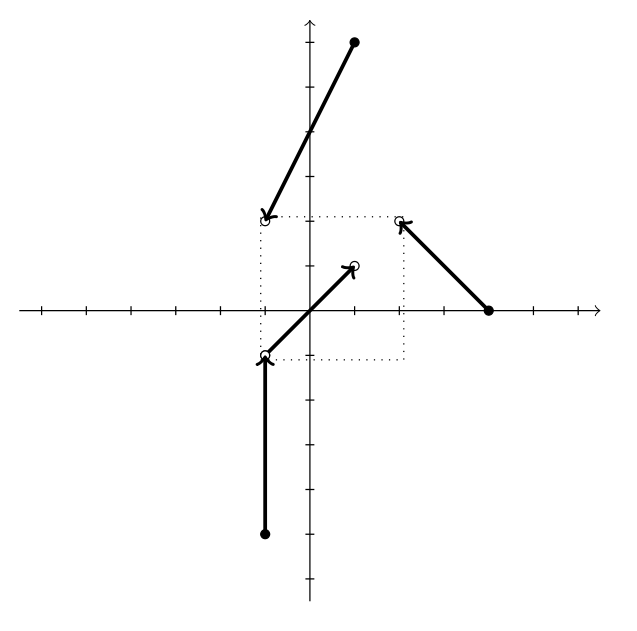
The drawing shows the initial positions of the fireflies and the path they traveled over two units of time. A square with side length 3 is also marked, which contains all the fireflies at time $t = 2$.