Little D loves filling games. Today, he is playing a filling game.
The board for this filling game is an $n \times m$ rectangular grid. The player needs to fill each cell of the grid with a digit (either 0 or 1), and the filling must satisfy certain constraints.
We describe these constraints in detail below. To facilitate the description, we first provide some definitions: We use the row and column coordinates of a cell to represent it, i.e., (row coordinate, column coordinate). (Note: Both row and column coordinates are 0-indexed.) A valid path $P$: A path is valid if and only if: 1. The path starts from the top-left cell $(0,0)$ of the rectangular grid and ends at the bottom-right cell $(n-1, m-1)$. 2. In this path, one can only move from the current cell to the adjacent cell on the right, or from the current cell to the adjacent cell below.
For example, in the rectangle below, there are two valid paths, which are $P_1: (0,0) \to (0,1) \to (1,1)$ and $P_2: (0,0) \to (1,0) \to (1,1)$.
For a valid path $P$, we can represent it with a string $w(P)$ of length $n+m-2$, which contains only the characters "R" or "D". The $i$-th character records the $i$-th move in path $P$, where "R" represents moving to the adjacent cell on the right, and "D" represents moving to the adjacent cell below. For example, in the figure above for path $P_1$, $w(P_1) = \text{"RD"}$; for the other path $P_2$, $w(P_2) = \text{"DR"}$.
At the same time, concatenating the digits filled in the cells that a valid path $P$ passes through yields a 01-string of length $n+m-1$, denoted as $s(P)$. For example, if we fill the cells $(0,0)$ and $(1,0)$ with the digit 0, and fill the cells $(0,1)$ and $(1,1)$ with the digit 1 (see the red digits in the figure above), then for path $P_1$, we get $s(P_1) = \text{"011"}$, and for path $P_2$, $s(P_2) = \text{"001"}$.
The game requires Little D to find a way to fill the digits 0 and 1 such that for any two valid paths $P_1$ and $P_2$, if $w(P_1) > w(P_2)$, then $s(P_1) \le s(P_2)$. We say string $a$ is smaller than string $b$ if and only if the lexicographical order of string $a$ is less than the lexicographical order of string $b$. Little D wants to know how many ways there are to fill the digits to satisfy the game's requirements.
Little D has limited ability and hopes you can help him solve this problem, i.e., how many ways to fill 0s and 1s satisfy the problem requirements. Since the answer can be very large, you need to output the answer modulo $10^9 + 7$.
Input
The input consists of a single line containing two integers $n$ and $m$, separated by a space, representing the size of the rectangle. $n$ represents the number of rows in the rectangular grid, and $m$ represents the number of columns in the rectangular grid.
Output
Output a single line containing an integer, representing the number of ways to fill the digits 0 and 1 that satisfy the game's requirements. Note: Output the answer modulo $10^9 + 7$.
Examples
Input 1
2 2
Output 1
12
Note 1
For a $2 \times 2$ board, the 12 filling methods shown in the figure above satisfy the requirements.
Input 2
3 3
Output 2
112
Input 3
5 5
Output 3
7136
Constraints
| Test Case ID | $n \le$ | $m \le$ |
|---|---|---|
| 1~4 | 3 | 3 |
| 5~10 | 2 | 1000000 |
| 11~13 | 3 | 1000000 |
| 14~16 | 8 | 8 |
| 17~20 | 8 | 1000000 |
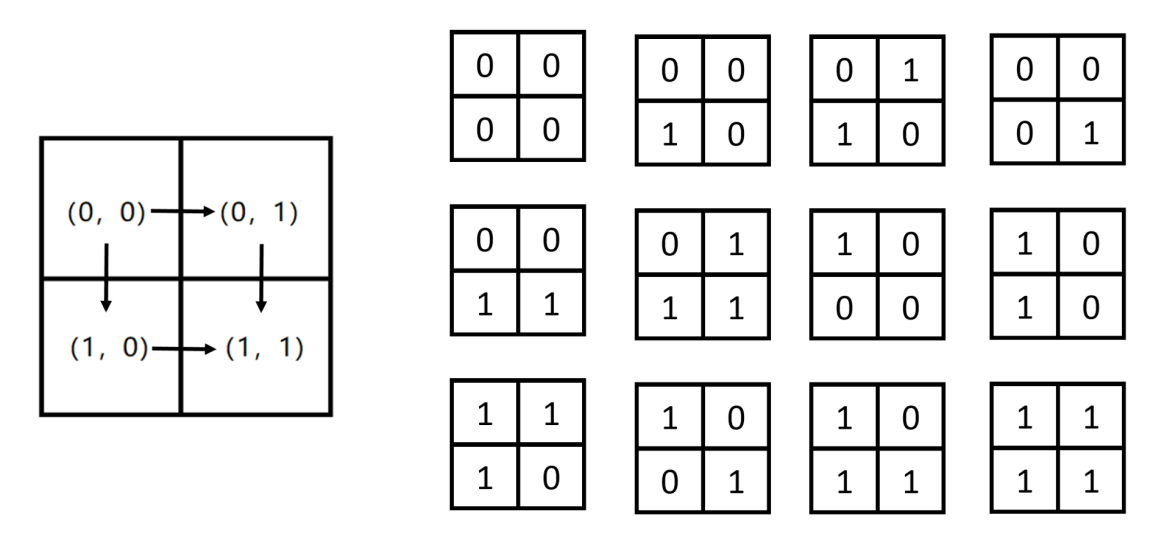
Figure 1. A $2 \times 2$ grid showing valid paths.