Little T is studying events that occurred over a certain period. Observations show that $n$ events, numbered $1 \sim n$, occurred sequentially during this period, and the $i$-th event to occur was event $p_i$. This permutation $p$, which describes the order of events, can be called the "timeline" of this period.
Suddenly, the evil creature Little S attacked this timeline, changing the occurrence order $p$ of these $n$ events to a permutation chosen uniformly at random from all permutations of length $n$. Furthermore, Little S used scissors to cut the timeline, performing $k$ operations to divide the permutation $p$ into $(k+1)$ segments.
Specifically, when Little S performs the $i$-th operation, the permutation $p$ and all previously inserted cut points form a sequence of length $(n+i-1)$. This sequence has $(n+i)$ insertion positions, including those between all adjacent elements and at the beginning and end of the sequence. Little S chooses one of these insertion positions uniformly at random and inserts a new cut point. Finally, Little S cuts the sequence at the $k$ inserted cut points, dividing the permutation $p$ into $(k+1)$ segments. These $(k+1)$ segments may include empty sequences.
To save this timeline from destruction, Little T decides to reassemble these $(k+1)$ segments in some order to form a new permutation of length $n$, creating a new timeline. However, due to certain logical relationships between events, there are requirements on the relative order of event occurrences. Research shows there are $m$ precedence requirements $(u, v)$, requiring that event $u$ must occur before event $v$. That is, the position of $u$ in the timeline must be before $v$.
Please design a program to calculate the probability that there exists at least one way to reorder these $(k+1)$ segments and splice them into a new timeline such that all $m$ precedence requirements are satisfied.
To avoid precision errors, please output the result modulo $10^9+7$. Formally, it can be proven that the answer can be expressed as an irreducible fraction $\frac{p}{q}$, and you should output an integer $x$ such that $0 \le x < 10^9+7$ and $qx \equiv p \pmod{10^9+7}$. It can be proven that such an $x$ always exists under the problem conditions.
Input
Read data from the file timeline.in.
The first line contains three integers $n, m, k$, describing the number of events, the number of precedence requirements, and the number of cut operations performed by Little S, respectively.
The next $m$ lines each contain two integers $u, v$, representing a precedence requirement that event $u$ must occur before event $v$.
Output
Output to the file timeline.out.
Output a single integer representing the required answer.
Examples
Input 1
2 1 1
1 2
Output 1
666666672
Input 2
3 0 2
Output 2
1
Input 3
4 4 4
1 2
1 3
1 4
2 4
Output 3
937500007
Input 4
See timeline/timeline4.in and timeline/timeline4.ans in the contestant directory.
Input 5
See timeline/timeline5.in and timeline/timeline5.ans in the contestant directory.
This set of examples satisfies special property B.
Input 6
See timeline/timeline6.in and timeline/timeline6.ans in the contestant directory.
This set of examples satisfies special property A.
Input 7
See timeline/timeline7.in and timeline/timeline7.ans in the contestant directory.
Constraints
For all test data: $1 \le n \le 15$ $0 \le m \le \frac{n(n-1)}{2}$, $0 \le k \le n$ * $1 \le u < v \le n$, it is guaranteed that no two pairs $(u, v)$ are identical.
| Test Case | $n$ | $m$ | $k$ | Special Property |
|---|---|---|---|---|
| 1 | $\le 3$ | $= n-1$ | $= 0$ | B |
| 2 | $\le 5$ | $\le \frac{n(n-1)}{2}$ | $\le n$ | None |
| 3, 4 | $\le 14$ | $= n-1$ | $\le n$ | B |
| 5 | $= 0$ | A | ||
| 6 | $= n-1$ | None | ||
| 7, 8 | $= \frac{n(n-1)}{2}$ | None | ||
| 9, 10 | $\le 9$ | $\le 15$ | None | |
| 11 | $\le 13$ | $\le \frac{n(n-1)}{2}$ | $= 0$ | None |
| 12 | $\le n$ | None | ||
| 13 $\sim$ 17 | $\le 14$ | $\le \frac{n(n-1)}{2}$ | $\le n$ | None |
| 18 $\sim$ 20 | $\le 15$ | $\le \frac{n(n-1)}{2}$ | $\le n$ | None |
Special Property A: For each event $x$, there is at most one precedence requirement $(u, v)$ such that $v = x$. Special Property B: For all precedence requirements $(u, v)$, $u = 1$ is satisfied.
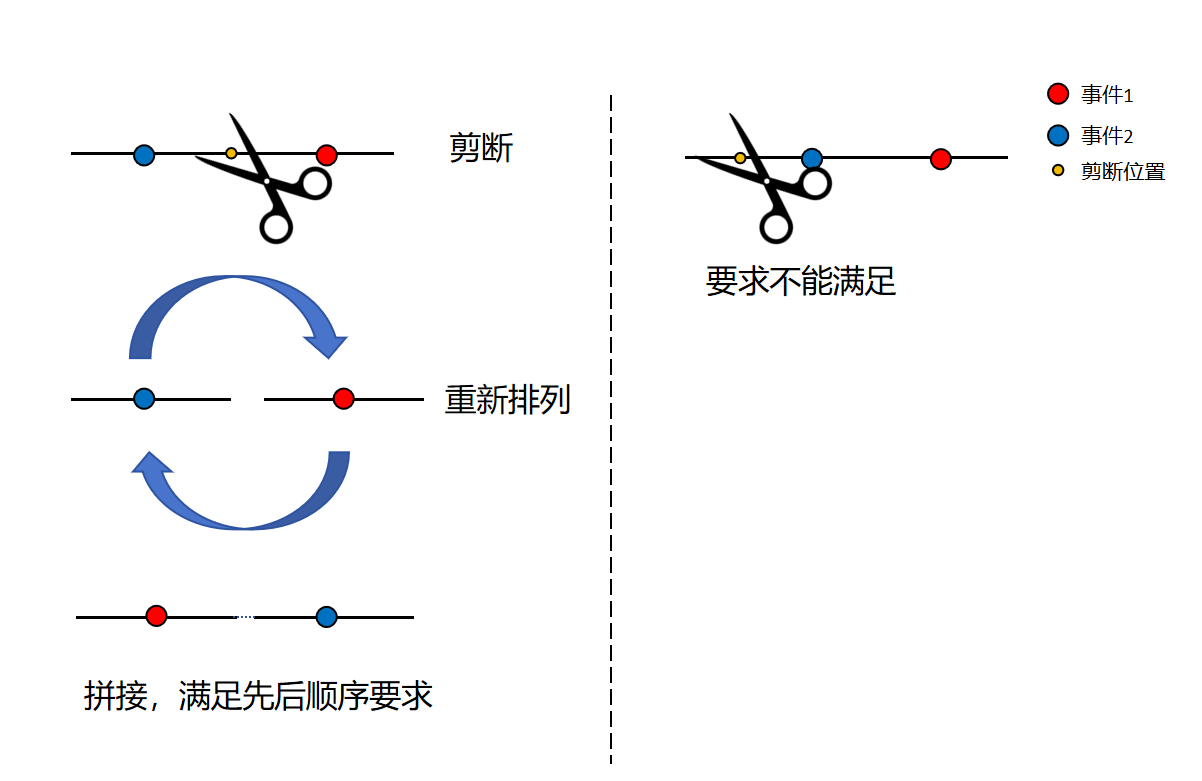
Figure 1. Illustration of the cutting, reordering, and splicing process to satisfy precedence requirements.