We have the following two types of tetrominoes:
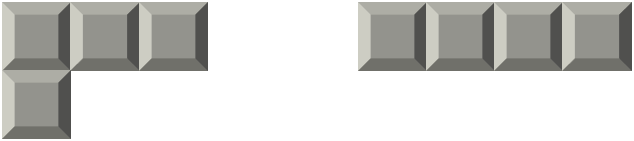
Figure 1: Available tetromino types
Both types of tetrominoes can be used an unlimited number of times and can be flipped, mirrored, or rotated by $90^\circ/180^\circ/270^\circ$.
Construct a tiling of an $n \times m$ grid that covers the grid without overlaps or gaps, or report that no such tiling exists.
For example, the figure below shows one valid tiling for a $6 \times 8$ grid:
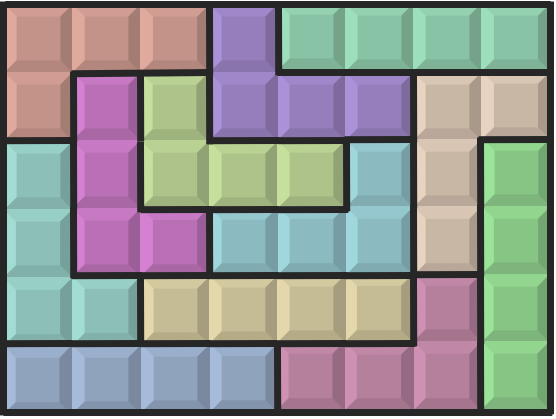
Figure 2: A valid tiling
Input
The input may contain multiple test cases. The first line contains the number of test cases $T$ ($1 \le T \le 10^5$).
For each test case, a single line contains two integers $n$ and $m$ ($n \times m \le 10^5, n, m \ge 1$), representing the number of rows and columns of the grid.
The sum of $n \times m$ over all test cases does not exceed $2 \times 10^5$.
Output
For each test case:
First, output "YES" or "NO" (case-sensitive) to indicate whether a solution exists.
If a solution exists, output $n$ lines, each containing $m$ integers, describing the tiling. Each tetromino is assigned a unique positive integer ID starting from 1. The ID must appear exactly 4 times in the $n \times m$ grid to identify the position of that tetromino. You are not allowed to skip IDs; that is, before using an ID $k$ ($k > 1$), you must have already used IDs $1, 2, \dots, k-1$.
If there are multiple valid tilings, you may output any one of them.
Examples
Input 1
3
2 3
2 4
6 8
Output 1
NO
YES
1 1 1 1
2 2 2 2
YES
1 1 1 2 11 11 11 11
1 4 5 2 2 2 12 12
8 4 5 5 5 6 12 10
8 4 4 6 6 6 12 10
8 8 9 9 9 9 7 10
3 3 3 3 7 7 7 10