In the Python language, converting a string to a list and then back to a str type results in a new string. The following console output describes this process.
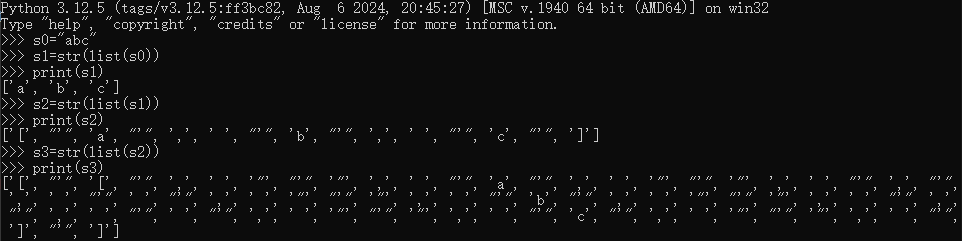
Figure 1. Console output describing the string transformation process
We formally describe the transformation from $s$ to str(list(s)) as follows. To obtain str(list(s)), we replace each character $s_i$ ($0 \le i < |s|$) in $s$ with a string $t_{i,0}t_{i,1}t_{i,2}t_{i,3}t_{i,4}$ of length 5, generated by the following rules:
- $t_{i,2} = s_i$.
- If $s_i$ is not a single quote
', then $t_{i,1}$ and $t_{i,3}$ are both single quotes'(ASCII 39); otherwise, $t_{i,1}$ and $t_{i,3}$ are both double quotes"(ASCII 34). - If $i = 0$, $t_{i,0}$ is a space
' '(ASCII 32); otherwise, it is a left bracket[(ASCII 91). - If $i = |s| - 1$, $t_{i,4}$ is a comma
,(ASCII 44); otherwise, it is a right bracket](ASCII 93).
Now, given a string $s$ consisting of visible characters other than whitespace (i.e., all characters with ASCII codes from 33 to 126), let $s^0 = s$. For an integer $i > 0$, define $s^i = \text{str}(\text{list}(s^{i-1}))$. Given two integers $k$ and $p$, for each $0 \le j < p$, calculate the sum of the ASCII codes of all characters in $s^k$ whose indices are congruent to $j \pmod p$. String indices are 0-indexed. If no character exists at an index congruent to $j \pmod p$, the answer is 0. The answer may be very large, so you must output the result modulo $(10^9 + 7)$.
Input
The input is read from standard input. The first line contains a string $s$ consisting of visible characters other than whitespace ($1 \le |s| \le 10^5$). The second line contains two integers $k, p$ ($1 \le k, p \le 3,000$).
Output
Output to standard output. Output a single line containing $p$ integers, where the $(j+1)$-th integer represents the sum of the ASCII codes of all characters in $s^k$ at indices congruent to $j \pmod p$, modulo $(10^9 + 7)$.
Examples
Input 1
abc
1 16
Output 1
91 39 97 39 44 32 39 98 39 44 32 39 99 39 93 0
Note 1
The final string $s^1$ in this example is the same as $s^1$ in the Python console process described in the problem statement.
Input 2
abc
2 7
Output 2
472 420 580 408 474 439 429
Note 2
The final string $s^2$ in this example is the same as $s^2$ in the Python console process described in the problem statement.
Input 3
(See 3.in in the problem directory)
Output 3
(See 3.ans in the problem directory)
Note 3
The string in this example contains all visible characters other than whitespace.