小明是一名小学生。有一天,他的数学老师指导学生们制作一系列特殊的模型,这些模型被称为“绝对空间”。每个模型由三维空间中的许多星星组成,并关联一个特殊参数 $n$,要求模型中的任意一颗星星,都有且仅有 $n$ 颗星星与其欧几里得距离为 1。
例如,对于 $n = 1$ 的情况,你可以通过画一条长度为 1 的线段,并在该线段的两个端点处放置星星来创建此模型。类似地,对于 $n = 2$,你可以通过画一个边长为 1 的正多边形(即等边三角形、正方形或正五边形),并在多边形的顶点处放置星星来创建此模型。如你所见,存在无穷多种“绝对空间”。
在课堂上,老师教了他们 $n = 1, 2$ 时的情况,而他们的家庭作业是为 $n = 3$ 创建一个模型。由于作业太简单了,小明不想止步于这些小情况。他花了一整晚思考,最终设法找到了适用于任何参数 $n$($n = 1, 2, 3, 4, 5, \dots$)的解。此外,他还找到了在创建这些模型时减少星星数量的方法。
如此巨大的进步既让他欣喜若狂,也让他彻夜难眠。第二天早上起床时,他完全忘记了自己是怎么想到的,而且由于他错误地使用了过期的胶水,他的草稿模型也坍塌了,所以他没有证据向老师证明他所做的一切。你能为这个可怜的小男孩创建一个模型吗?
给定参数 $n$,你的任务是创建一个可能的模型,使得星星的数量不超过某个限制。
输入格式
仅一行,包含一个整数 $n$($1 \le n \le 10$),表示模型的参数。
输出格式
第一行输出一个整数 $m$($1 \le m \le 100$),表示你模型中星星的数量。
接下来的 $m$ 行,每行输出一颗星星的坐标,即输出三个实数 $x, y, z$($-100 \le x, y, z \le 100$),表示在点 $(x, y, z)$ 处的一颗星星。此外,输出中的任意两点之间的欧几里得距离不得小于 0.01。
为了容忍精度误差,如果对于你模型中的每一颗星星,都有且仅有 $n$ 颗星星与其欧几里得距离在区间 $(0.999\,999, 1.000\,001)$ 内,则你的模型将被视为有效。
样例
输入 1
1
输出 1
2
0.000000000 0.000000000 0.000000000
1.000000000 0.000000000 0.000000000
输入 2
2
输出 2
3
0.000000000 0.000000000 0.000000000
1.000000000 0.000000000 0.000000000
0.500000000 0.866025404 0.000000000
输入 3
3
输出 3
4
0.500000000 0.000000000 -0.353553391
-0.500000000 0.000000000 -0.353553391
0.000000000 0.500000000 0.353553391
0.000000000 -0.500000000 0.353553391
输入 4
4
输出 4
6
0.707106781 0.000000000 0.000000000
-0.707106781 0.000000000 0.000000000
0.000000000 0.707106781 0.000000000
0.000000000 -0.707106781 0.000000000
0.000000000 0.000000000 0.707106781
0.000000000 0.000000000 -0.707106781
输入 5
5
输出 5
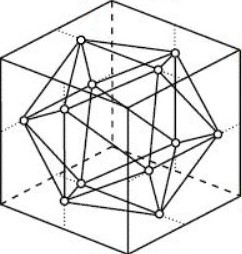
12
0.000000000 0.500000000 0.809016994
0.000000000 -0.500000000 0.809016994
0.000000000 0.500000000 -0.809016994
0.000000000 -0.500000000 -0.809016994
0.500000000 0.809016994 0.000000000
0.500000000 -0.809016994 0.000000000
-0.500000000 0.809016994 0.000000000
-0.500000000 -0.809016994 0.000000000
0.809016994 0.000000000 0.500000000
0.809016994 0.000000000 -0.500000000
-0.809016994 0.000000000 0.500000000
-0.809016994 0.000000000 -0.500000000
说明
对于样例: 长度为 1 的线段是 $n = 1$ 的可行模型; 等边三角形是 $n = 2$ 的可行模型; 正四面体是 $n = 3$ 的可行模型; 正八面体是 $n = 4$ 的可行模型; * 正二十面体是 $n = 5$ 的可行模型,如上图所示。